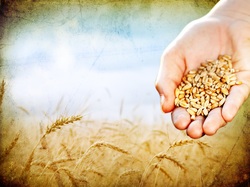
"The parable of the Wheat and Tares" and "The Mustard Seed"
Matthew 13:24-30
" Another parable put he forth unto them, saying, The kingdom of heaven is likened unto a man which sowed good seed in his field: But while men slept, his enemy came and sowed tares among the wheat, and went his way. But when the blade was sprung up, and brought forth fruit, then appeared the tares also. So the servants of the householder came and said unto him, Sir, didst not thou sow good seed in thy field? from whence then hath it tares? He said unto them, An enemy hath done this. The servants said unto him, Wilt thou then that we go and gather them up? But he said, Nay; lest while ye gather up the tares, ye root up also the wheat with them. Let both grow together until the harvest: and in the time of harvest I will say to the reapers, Gather ye together first the tares, and bind them in bundles to burn them: but gather the wheat into my barn. (KJV)
Matthew 13:24-30
" Another parable put he forth unto them, saying, The kingdom of heaven is likened unto a man which sowed good seed in his field: But while men slept, his enemy came and sowed tares among the wheat, and went his way. But when the blade was sprung up, and brought forth fruit, then appeared the tares also. So the servants of the householder came and said unto him, Sir, didst not thou sow good seed in thy field? from whence then hath it tares? He said unto them, An enemy hath done this. The servants said unto him, Wilt thou then that we go and gather them up? But he said, Nay; lest while ye gather up the tares, ye root up also the wheat with them. Let both grow together until the harvest: and in the time of harvest I will say to the reapers, Gather ye together first the tares, and bind them in bundles to burn them: but gather the wheat into my barn. (KJV)
The parable is an expansion of the parable of the sower. This parable deals with the character of the seed sown as opposed to the character of the sower. As we all know the Sower is Jesus Christ ( the Son of Man) and the seed that he's sowing in is "Word of God". the seed sown are good seed, guaranteed to grow and the produce fruit.Christ has sown His Word into the world, The church is not the field, neither does the "wheat" or the "tares" represent true worshippers or false worshippers, nor do they represent true prophets or false prophets. The field represents the "world," in which the gospel is preached. The "good seed," the truths preached by Christ and his apostles.
I. Matthew Henry's Commentary breaks this parable down completely. Observe:
(1.) He that sows the good seed is the Son of man.
Jesus Christ is the Lord of the field, the Lord of the harvest, the Sower of good seed. When he ascended on high, he gave gifts to the world; not only good ministers, but other good men.
Note, Whatever good seed there is in the world, it all comes from the hand of Christ, and is of his sowing: truths preached, graces planted, souls sanctified, are good seed, and all owing to Christ. Ministers are instruments in Christ's hand to sow good seed; are employed by him and under him, and the success of their labous depends purely upon his blessing; so that it may well be said, It is Christ, and no other, that sows the good seed; he is the Son of man, one of us, that his terror might not make us afraid; the Son of man, the Mediator, and that has authority.
(2.) The field is the world;
The world of mankind is a large field, capable of bringing forth good fruit. The more is it to be lamented that it brings forth so much bad fruit: The world here is the visible church, that is, people that are to be saved and are scattered all the world over, comprised of both Jews and Gentiles.. Observe, In the parable it is called "his field" because the world is Christ's field. All things are delivered unto him of the Father: Whatever power and interest the devil has in the world, it is usurped, taken by deception and the use of wicked devices and people, thus the enemy's claims are false and unjust. When Christ comes to take possession of the "field" (world), He has legal right to both posess it and repossess the"usurped authority" the devil laid claim to. It is Christ's field because he took care to sow it with good seed.
(3.) The good seed are the children of the kingdom, true saints. They are:
[a] The "children of the kingdom" not by profession only, as the Jews were (chapter. 8:12), but in sincerity; Jews inwardly, Israelites indeed, incorporated in faith and obedience to Jesus Christ the great King of the church.
[b.] They are the good seed, precious as seed, (Psalms 126:6). The seed is the substance of the field; so the holy seed, (Isaiah 6:13). The seed is scattered, so are the saints; dispersed, here one and there another, though in some places thicker sown than in others. The seed is that from which fruit is expected; what fruit of honor and service God has from this world he has from the saints, whom he has sown unto himself in the earth, (Hosea 2:23).
(4.) The tares are the children of the wicked one.
Here is the character of sinners, hypocrites, and all profane and wicked people.
[a.] They are the children of the devil, as a wicked one. Though they do not own his name, yet they bear his image, do his lusts, and from him they have their education; he rules over them, he works in them, (Ephesians 2:2; John 8:44).
[b.] They are tares in the field of this world; They do no good They cause others harm. They are unprofitable in themselves, and hurtful to the good seed, both by temptation and persecution: They are weeds in the garden, They receive the same rain, and sunshine, and soil, with the good plants, but are good for nothing: They tares tares sown among the wheat. Note, God has so ordered it, that good and bad should be mixed together in this world, that the good may be exercised, the bad left inexcusable, and a difference made between earth and heaven.
(5.) The enemy that sowed the tares is the devil;
The Devil is a sworn enemy to Christ and all that is good, to the glory of the good God, and the comfort and happiness of all good men. He is an enemy to the field of the world, which he endeavors to make his own, by sowing his tares in it. Ever since he became a wicked spirit himself, he has been industrious to promote wickedness, and has made it his business, aiming therein to counter the work of Christ.
6.) The harvest is the end of the world,
This world will have an end; though it continue long, it will not continue always; time will shortly be swallowed up in eternity. At the end of the world, there will be a great harvest-day, a day of judgment; at harvest all is ripe and ready to be cut down: both good and bad are ripe at the great-day, (Revelation 6:11). It is the harvest of the earth,( Revelation 14:15). At harvest the reapers cut down all before them; not a field, not a corner, is left behind; so at the great day all must be judged (Revelation 20:12,13); God has set a harvest (Hosea 6:11), and it shall not fail, Genesis 8:22. At harvest every man reaps as he sowed; every man's ground, and seed, and skill, and industry, will be manifested: see (Galatians 6:7-8). Then they who sowed precious seed, will come again with rejoicing (Psalms 126:5,6), with the joy of harvest (Isaiah 9:3); when the sluggard, who would not plow by reason of cold, shall beg, and have nothing (Proverbs 20:4); shall cry, Lord, Lord, but in vain; when the harvest of those who sowed to the flesh, shall be a day of grief, and of desperate sorrow, (Isaiah 17:11.)
(7.) The reapers are the angels: they shall be employed, in the great day, in executing Christ's righteous sentences, both of approbation and condemnation, as ministers of his justice, ch. 25:31. The angels are skillful, strong, and swift, obedient servants to Christ, holy enemies to the wicked, and faithful friends to all the saints, and therefore fit to be thus employed. He that reaps receives wages, and the angels will not be unpaid for their attendance; for he that sows, and he that reap, shall rejoice together (John 4:36); that is joy in heaven in the presence of the angels of God.
(8.) Hell-torments are the fire, into which the tares shall then be cast, and in which they shall be burned. At the great day a distinction will be made, and with it a vast difference; it will be a notable day indeed.
II. Now concerning the sowing of the tares, observe in the parable,
[1.] That they were sown while men slept. Magistrates slept, who by their power, ministers slept, who by their preaching, should have prevented this mischief. This gives you some insight about how Satan operates:
(A.) Satan watches all opportunities, and takes advantage of all opportunities, to propagate vice and profaneness. The prejudice he does to particular persons is when reason and conscience sleep, when they are off their guard; we have therefore need to be sober, and vigilant. It was in the night, for that is the sleeping time.
(B.) Satan rules in the darkness of this world; that gives him an opportunity to sow tares, (Psalms 104:20). It was while men slept; and there is no remedy but men must have some sleeping time. Note, It is as impossible for us to prevent hypocrites being in the church, as it is for the husbandman, when he is asleep, to hinder an enemy from spoiling his field.
[2.] The enemy, when he had sown the tares, went his way (v. 25), that it might not be known who did it. Note, When Satan is doing the greatest mischief, he studies most to conceal himself; for his design is in danger of being spoiled if he be seen in it; and therefore, when he comes to sow tares, he transforms himself into an angel of light, (2 Corinthians 11:13,14.) He went his way, as if he had done no harm; such is the way of the adulterous woman, (Proverbs 30:20). Observe, Such is the proneness of fallen man to sin, that if the enemy sow the tares, he may even go his way, they will spring up of themselves and do hurt; whereas, when good seed is sown, it must be tended, watered, and fenced, or it will come to nothing.
[3.] The tares appeared not till the blade sprung up, and brought forth fruit, (v. 26).
There is a great deal of secret wickedness in the hearts of men, which is long hid under the cloak of a plausible profession, but at some point comes forth and reveals itself. The "growth" process for both the "seed" and the "tare" are the same. They both lie buried under the soil and when they first spring up, it is hard to distinguish them; but when "trying time" comes, at the time fruit is to be brought forth, when good is to be done that has difficulty and hazard doing it, then you will return and discern the difference between the good fruit (sincere) and that which is weeds (the hypocrite): then you may say, This is wheat, and that is tares.
I. The reaction of the workers in the field
When the servants, noticed the many weeds in the planted field, complained to their master. Sir, didst thou not sow good seed in thy field? No doubt he did;
Pertaining to the church: whatever is amiss and has gone wrong in the church, Christ certainly is not the author of confusion, considering the seed (Word) which Christ sows, we may well ask, with wonder, Whence should these tares come?
Note: The rise of doctrinal errors, the breaking out of scandals, and the growth of profaneness, are and should be matters of great grief to all the servants of Christ; especially to his faithful ministers, who are directed to complain of it to him whose the field is. It is sad to see such tares, such weeds, in the garden of the Lord; to see the good soil wasted, the good seed choked, and such a reflection cast on the name and honor of Christ, as if his field were no better than the field of the slothful, all grown over with thorns.
II. Christ responds to the servants inquiry
Jesus responded: An enemy (Satan) has done this. He didn't blame the servants. But notice even though they could not prevent the enemy from attacking the field, they had properly sowed the field and the enemy sowed tares in the field under the cloak of darkness. Regardless of the church or denomination or claim of "non-denomination", found within the fellowship will be a mixture of bad with good, hypocrites with the sincere, in the field of the church. Remember, Jesus said in this life we will have tribulation but to remember with good cheer that He has already overcome the world. It it of necessity that such offences will come; and when they do, they shall not be laid to our charge. the key is we must continue to do our duties as call and chosen ministers of the Gospel to do our duty, though it.
III. The Zealous reaction of the Servants
The servants were very forward to have these tares rooted up. "Wilt thou that we go and do it presently?" Note, The over-hasty and inconsiderate zeal of Christ's servants, before they have consulted with their Master, is sometimes ready, with the hazard of the church, to root out all that they presume to be tares: Lord, wilt thou that we call for fire from heaven? It's important every servant of God prays to seek God's instructions to properly handle any situation that occurs in the church. by praying (seeking) God's directions, the Master very wisely prevented them from rooting up wheat that looked like tares. Jesus said: "Nay, lest while ye gather up the tares, ye root up also the wheat with them".
Note, Because man is infallable and prone to error, it is not possible for any man without the discerning power of the Holy Spirit to distinguish between wheat and tares in their tender state. Christ, in His infinite wisdom will rather permit the tares, than endanger the wheat in any way. It is certain that scandalous offenders are to be censured, in fact,we are to withdraw from them. We are to come out from among them and separate ourselves from close association.
I say close association because we are to witness and live a life of holiness among all who we come in contact with. Yet, those who are openly the children of the wicked one, are not to be admitted to special ordinances, as this may prove vexatious to many that are truly godly and conscientious. As far as church discipline is concerned, great caution and moderation must be used in inflicting and continuing church censures, lest the wheat be trodden down, if not plucked up. The wisdom from above, as it is pure, so it is peaceable, and those who oppose themselves must not be cut off, but instructed, and with meekness, 2 Timothy 2:25. The tares, if continued under the means of grace, may become good corn; therefore have patience with them.
IV. The Fate of both the Wheat and Tares: (Harvest- Judgment)
[1.] The tares will then be gathered out:
The reapers (whose primary work it is to gather in the corn) shall be charged first to gather out the tares.
Note, Though good and bad are together in this world undistinguished, yet at the great day (judgment) they shall be parted; On that day, no tares shall then be among the wheat; that is, no sinners will be among the saints: On this day you will plainly be able to identify the righteous and the wicked, which here sometimes it is hard to do, Malachi 3:18; 4:1.
Christ will not bear always, (Psalms 50:1), They shall gather out of his kingdom all wicked things that offend, and all wicked persons that do iniquity: when he begins, he will make a full end. All those corrupt doctrines, worships, and practices, which have offended, have been scandals to the church, and stumbling-blocks to men's consciences, shall be condemned by the righteous Judge in that day, and consumed by the brightness of his coming; all the wood, hay, and stubble
1 Corinthians 3:12); and then woe to them that do iniquity, that make a trade of it, and persist in it; not only those in the last age of Christ's kingdom upon earth, but those in every age. Perhaps here is an allusion to Zephaniah 1:3: "I will consume the stumbling-blocks with the wicked"
.
[2.] They will then be bound in bundles, (v. 30).
"Sinners" of the same sort will be bundled together in the great day: a bundle of atheists, a bundle of epicures, a bundle of persecutors, and a great bundle of hypocrites. Those who have been associates in sin, will be so in shame and sorrow; and it will be an aggravation of their misery, as the society of glorified saints will add to their bliss. Let us pray, as David, Lord, gather not my soul with sinners (Psalms 26:9), but let it be bound in the bundle of life, with the Lord our God, 1 Samuel 25:29.
[3.] They will be cast into a furnace of fire; "The Wicked"
This will be the "ultimate" end of wicked, mischievous people, those who God has classified as tares within the church.
Note, Hell is a furnace of fire, kindled by the wrath of God, and kept burning by the bundles of tares cast into it, who will be ever in the consuming, but never consumed. But he slides out of the metaphor into a description of those torments that are designed to be set forth by it: There shall be weeping, and gnashing of teeth; comfortless sorrow, and an incurable indignation at God, themselves, and one another, will be the endless torture of damned souls. Let us therefore, knowing these terrors of the Lord, be persuaded not to do iniquity.
V. The fate of the Wheat (Righteous)
Heaven is the barn into which all God's wheat shall be gathered in that harvest-day. But gather the wheat into my barn: so it is in the parable
Note: In the field of this world good people are the wheat, the most precious grain, and the valuable part of the field. This wheat shall shortly be gathered, gathered from among the tares and weeds: all gathered together in a general assembly, all the Old-Testament saints, all the New-Testament saints, not one missing. Gather my saints together unto me, Psalms 50:5.
All God's wheat shall be lodged together in God's barn: particular souls are housed at death as a shock of corn (Job 5:26), but the general in-gathering will be at the end of time: God's wheat will then be put together, and no longer scattered; there will be sheaves of corn, as well as bundles of tares: they will then be secured, and no longer exposed to wind and weather, sin and sorrow: no longer afar off, and at a great distance, in the field, but near, in the barn. Nay, heaven is a garner (chapter 3:12), in which the wheat will not only be separated from the tares of ill companions, but sifted from the chaff of their own corruptions.
Dr. William Edward Boddie
I. Matthew Henry's Commentary breaks this parable down completely. Observe:
(1.) He that sows the good seed is the Son of man.
Jesus Christ is the Lord of the field, the Lord of the harvest, the Sower of good seed. When he ascended on high, he gave gifts to the world; not only good ministers, but other good men.
Note, Whatever good seed there is in the world, it all comes from the hand of Christ, and is of his sowing: truths preached, graces planted, souls sanctified, are good seed, and all owing to Christ. Ministers are instruments in Christ's hand to sow good seed; are employed by him and under him, and the success of their labous depends purely upon his blessing; so that it may well be said, It is Christ, and no other, that sows the good seed; he is the Son of man, one of us, that his terror might not make us afraid; the Son of man, the Mediator, and that has authority.
(2.) The field is the world;
The world of mankind is a large field, capable of bringing forth good fruit. The more is it to be lamented that it brings forth so much bad fruit: The world here is the visible church, that is, people that are to be saved and are scattered all the world over, comprised of both Jews and Gentiles.. Observe, In the parable it is called "his field" because the world is Christ's field. All things are delivered unto him of the Father: Whatever power and interest the devil has in the world, it is usurped, taken by deception and the use of wicked devices and people, thus the enemy's claims are false and unjust. When Christ comes to take possession of the "field" (world), He has legal right to both posess it and repossess the"usurped authority" the devil laid claim to. It is Christ's field because he took care to sow it with good seed.
(3.) The good seed are the children of the kingdom, true saints. They are:
[a] The "children of the kingdom" not by profession only, as the Jews were (chapter. 8:12), but in sincerity; Jews inwardly, Israelites indeed, incorporated in faith and obedience to Jesus Christ the great King of the church.
[b.] They are the good seed, precious as seed, (Psalms 126:6). The seed is the substance of the field; so the holy seed, (Isaiah 6:13). The seed is scattered, so are the saints; dispersed, here one and there another, though in some places thicker sown than in others. The seed is that from which fruit is expected; what fruit of honor and service God has from this world he has from the saints, whom he has sown unto himself in the earth, (Hosea 2:23).
(4.) The tares are the children of the wicked one.
Here is the character of sinners, hypocrites, and all profane and wicked people.
[a.] They are the children of the devil, as a wicked one. Though they do not own his name, yet they bear his image, do his lusts, and from him they have their education; he rules over them, he works in them, (Ephesians 2:2; John 8:44).
[b.] They are tares in the field of this world; They do no good They cause others harm. They are unprofitable in themselves, and hurtful to the good seed, both by temptation and persecution: They are weeds in the garden, They receive the same rain, and sunshine, and soil, with the good plants, but are good for nothing: They tares tares sown among the wheat. Note, God has so ordered it, that good and bad should be mixed together in this world, that the good may be exercised, the bad left inexcusable, and a difference made between earth and heaven.
(5.) The enemy that sowed the tares is the devil;
The Devil is a sworn enemy to Christ and all that is good, to the glory of the good God, and the comfort and happiness of all good men. He is an enemy to the field of the world, which he endeavors to make his own, by sowing his tares in it. Ever since he became a wicked spirit himself, he has been industrious to promote wickedness, and has made it his business, aiming therein to counter the work of Christ.
6.) The harvest is the end of the world,
This world will have an end; though it continue long, it will not continue always; time will shortly be swallowed up in eternity. At the end of the world, there will be a great harvest-day, a day of judgment; at harvest all is ripe and ready to be cut down: both good and bad are ripe at the great-day, (Revelation 6:11). It is the harvest of the earth,( Revelation 14:15). At harvest the reapers cut down all before them; not a field, not a corner, is left behind; so at the great day all must be judged (Revelation 20:12,13); God has set a harvest (Hosea 6:11), and it shall not fail, Genesis 8:22. At harvest every man reaps as he sowed; every man's ground, and seed, and skill, and industry, will be manifested: see (Galatians 6:7-8). Then they who sowed precious seed, will come again with rejoicing (Psalms 126:5,6), with the joy of harvest (Isaiah 9:3); when the sluggard, who would not plow by reason of cold, shall beg, and have nothing (Proverbs 20:4); shall cry, Lord, Lord, but in vain; when the harvest of those who sowed to the flesh, shall be a day of grief, and of desperate sorrow, (Isaiah 17:11.)
(7.) The reapers are the angels: they shall be employed, in the great day, in executing Christ's righteous sentences, both of approbation and condemnation, as ministers of his justice, ch. 25:31. The angels are skillful, strong, and swift, obedient servants to Christ, holy enemies to the wicked, and faithful friends to all the saints, and therefore fit to be thus employed. He that reaps receives wages, and the angels will not be unpaid for their attendance; for he that sows, and he that reap, shall rejoice together (John 4:36); that is joy in heaven in the presence of the angels of God.
(8.) Hell-torments are the fire, into which the tares shall then be cast, and in which they shall be burned. At the great day a distinction will be made, and with it a vast difference; it will be a notable day indeed.
II. Now concerning the sowing of the tares, observe in the parable,
[1.] That they were sown while men slept. Magistrates slept, who by their power, ministers slept, who by their preaching, should have prevented this mischief. This gives you some insight about how Satan operates:
(A.) Satan watches all opportunities, and takes advantage of all opportunities, to propagate vice and profaneness. The prejudice he does to particular persons is when reason and conscience sleep, when they are off their guard; we have therefore need to be sober, and vigilant. It was in the night, for that is the sleeping time.
(B.) Satan rules in the darkness of this world; that gives him an opportunity to sow tares, (Psalms 104:20). It was while men slept; and there is no remedy but men must have some sleeping time. Note, It is as impossible for us to prevent hypocrites being in the church, as it is for the husbandman, when he is asleep, to hinder an enemy from spoiling his field.
[2.] The enemy, when he had sown the tares, went his way (v. 25), that it might not be known who did it. Note, When Satan is doing the greatest mischief, he studies most to conceal himself; for his design is in danger of being spoiled if he be seen in it; and therefore, when he comes to sow tares, he transforms himself into an angel of light, (2 Corinthians 11:13,14.) He went his way, as if he had done no harm; such is the way of the adulterous woman, (Proverbs 30:20). Observe, Such is the proneness of fallen man to sin, that if the enemy sow the tares, he may even go his way, they will spring up of themselves and do hurt; whereas, when good seed is sown, it must be tended, watered, and fenced, or it will come to nothing.
[3.] The tares appeared not till the blade sprung up, and brought forth fruit, (v. 26).
There is a great deal of secret wickedness in the hearts of men, which is long hid under the cloak of a plausible profession, but at some point comes forth and reveals itself. The "growth" process for both the "seed" and the "tare" are the same. They both lie buried under the soil and when they first spring up, it is hard to distinguish them; but when "trying time" comes, at the time fruit is to be brought forth, when good is to be done that has difficulty and hazard doing it, then you will return and discern the difference between the good fruit (sincere) and that which is weeds (the hypocrite): then you may say, This is wheat, and that is tares.
I. The reaction of the workers in the field
When the servants, noticed the many weeds in the planted field, complained to their master. Sir, didst thou not sow good seed in thy field? No doubt he did;
Pertaining to the church: whatever is amiss and has gone wrong in the church, Christ certainly is not the author of confusion, considering the seed (Word) which Christ sows, we may well ask, with wonder, Whence should these tares come?
Note: The rise of doctrinal errors, the breaking out of scandals, and the growth of profaneness, are and should be matters of great grief to all the servants of Christ; especially to his faithful ministers, who are directed to complain of it to him whose the field is. It is sad to see such tares, such weeds, in the garden of the Lord; to see the good soil wasted, the good seed choked, and such a reflection cast on the name and honor of Christ, as if his field were no better than the field of the slothful, all grown over with thorns.
II. Christ responds to the servants inquiry
Jesus responded: An enemy (Satan) has done this. He didn't blame the servants. But notice even though they could not prevent the enemy from attacking the field, they had properly sowed the field and the enemy sowed tares in the field under the cloak of darkness. Regardless of the church or denomination or claim of "non-denomination", found within the fellowship will be a mixture of bad with good, hypocrites with the sincere, in the field of the church. Remember, Jesus said in this life we will have tribulation but to remember with good cheer that He has already overcome the world. It it of necessity that such offences will come; and when they do, they shall not be laid to our charge. the key is we must continue to do our duties as call and chosen ministers of the Gospel to do our duty, though it.
III. The Zealous reaction of the Servants
The servants were very forward to have these tares rooted up. "Wilt thou that we go and do it presently?" Note, The over-hasty and inconsiderate zeal of Christ's servants, before they have consulted with their Master, is sometimes ready, with the hazard of the church, to root out all that they presume to be tares: Lord, wilt thou that we call for fire from heaven? It's important every servant of God prays to seek God's instructions to properly handle any situation that occurs in the church. by praying (seeking) God's directions, the Master very wisely prevented them from rooting up wheat that looked like tares. Jesus said: "Nay, lest while ye gather up the tares, ye root up also the wheat with them".
Note, Because man is infallable and prone to error, it is not possible for any man without the discerning power of the Holy Spirit to distinguish between wheat and tares in their tender state. Christ, in His infinite wisdom will rather permit the tares, than endanger the wheat in any way. It is certain that scandalous offenders are to be censured, in fact,we are to withdraw from them. We are to come out from among them and separate ourselves from close association.
I say close association because we are to witness and live a life of holiness among all who we come in contact with. Yet, those who are openly the children of the wicked one, are not to be admitted to special ordinances, as this may prove vexatious to many that are truly godly and conscientious. As far as church discipline is concerned, great caution and moderation must be used in inflicting and continuing church censures, lest the wheat be trodden down, if not plucked up. The wisdom from above, as it is pure, so it is peaceable, and those who oppose themselves must not be cut off, but instructed, and with meekness, 2 Timothy 2:25. The tares, if continued under the means of grace, may become good corn; therefore have patience with them.
IV. The Fate of both the Wheat and Tares: (Harvest- Judgment)
[1.] The tares will then be gathered out:
The reapers (whose primary work it is to gather in the corn) shall be charged first to gather out the tares.
Note, Though good and bad are together in this world undistinguished, yet at the great day (judgment) they shall be parted; On that day, no tares shall then be among the wheat; that is, no sinners will be among the saints: On this day you will plainly be able to identify the righteous and the wicked, which here sometimes it is hard to do, Malachi 3:18; 4:1.
Christ will not bear always, (Psalms 50:1), They shall gather out of his kingdom all wicked things that offend, and all wicked persons that do iniquity: when he begins, he will make a full end. All those corrupt doctrines, worships, and practices, which have offended, have been scandals to the church, and stumbling-blocks to men's consciences, shall be condemned by the righteous Judge in that day, and consumed by the brightness of his coming; all the wood, hay, and stubble
1 Corinthians 3:12); and then woe to them that do iniquity, that make a trade of it, and persist in it; not only those in the last age of Christ's kingdom upon earth, but those in every age. Perhaps here is an allusion to Zephaniah 1:3: "I will consume the stumbling-blocks with the wicked"
.
[2.] They will then be bound in bundles, (v. 30).
"Sinners" of the same sort will be bundled together in the great day: a bundle of atheists, a bundle of epicures, a bundle of persecutors, and a great bundle of hypocrites. Those who have been associates in sin, will be so in shame and sorrow; and it will be an aggravation of their misery, as the society of glorified saints will add to their bliss. Let us pray, as David, Lord, gather not my soul with sinners (Psalms 26:9), but let it be bound in the bundle of life, with the Lord our God, 1 Samuel 25:29.
[3.] They will be cast into a furnace of fire; "The Wicked"
This will be the "ultimate" end of wicked, mischievous people, those who God has classified as tares within the church.
Note, Hell is a furnace of fire, kindled by the wrath of God, and kept burning by the bundles of tares cast into it, who will be ever in the consuming, but never consumed. But he slides out of the metaphor into a description of those torments that are designed to be set forth by it: There shall be weeping, and gnashing of teeth; comfortless sorrow, and an incurable indignation at God, themselves, and one another, will be the endless torture of damned souls. Let us therefore, knowing these terrors of the Lord, be persuaded not to do iniquity.
V. The fate of the Wheat (Righteous)
Heaven is the barn into which all God's wheat shall be gathered in that harvest-day. But gather the wheat into my barn: so it is in the parable
Note: In the field of this world good people are the wheat, the most precious grain, and the valuable part of the field. This wheat shall shortly be gathered, gathered from among the tares and weeds: all gathered together in a general assembly, all the Old-Testament saints, all the New-Testament saints, not one missing. Gather my saints together unto me, Psalms 50:5.
All God's wheat shall be lodged together in God's barn: particular souls are housed at death as a shock of corn (Job 5:26), but the general in-gathering will be at the end of time: God's wheat will then be put together, and no longer scattered; there will be sheaves of corn, as well as bundles of tares: they will then be secured, and no longer exposed to wind and weather, sin and sorrow: no longer afar off, and at a great distance, in the field, but near, in the barn. Nay, heaven is a garner (chapter 3:12), in which the wheat will not only be separated from the tares of ill companions, but sifted from the chaff of their own corruptions.
Dr. William Edward Boddie


 RSS Feed